
What is a bioclimatic pergola and how does it work?
The principle behind a bioclimatic pergola is simple yet ingenious. The roof is neither solid nor fabric, but made up of a system of rotating aluminium louvres that respond to your needs or directly to the weather. This very flexibility is what makes a bioclimatic pergola more than just a shelter. It is an intelligent exterior element that combines architecture, comfort, and technology in one.
The principle of rotating louvres
The louvres tilt within a range of 0° to 140°, with each position serving a different purpose:
-
Fully open louvres let in maximum sunlight and air. Perfect for sunny mornings when you want to feel fully immersed in nature.
-
Partially rotated louvres regulate shading and airflow. The terrace remains pleasantly airy while shielded from direct sunlight.
-
Fully closed louvres form a waterproof roof. Rain, wind, snow — you stay outside and dry.
An important detail that customers come to appreciate later: rainwater does not run along the louvres but is channelled away through a concealed drainage system built directly into the support columns. No dripping, no puddles beneath the roof.
Manual vs. electric control
Basic models are operated manually using a hand crank. Premium versions, however, offer motorised control with a remote control, a mobile app, or integration into smart home systems. A pergola with remote control or a smart home pergola allows you to adjust the position of the louvres without getting up from your chair.
The most practical feature of all, though, are the weather sensors. When rain begins or strong wind picks up, the louvres close automatically — even if you are out shopping or at work. No more rushing to gather cushions, no more soaked terraces.
Why choose a bioclimatic pergola? The main advantages
Year-round use of the terrace
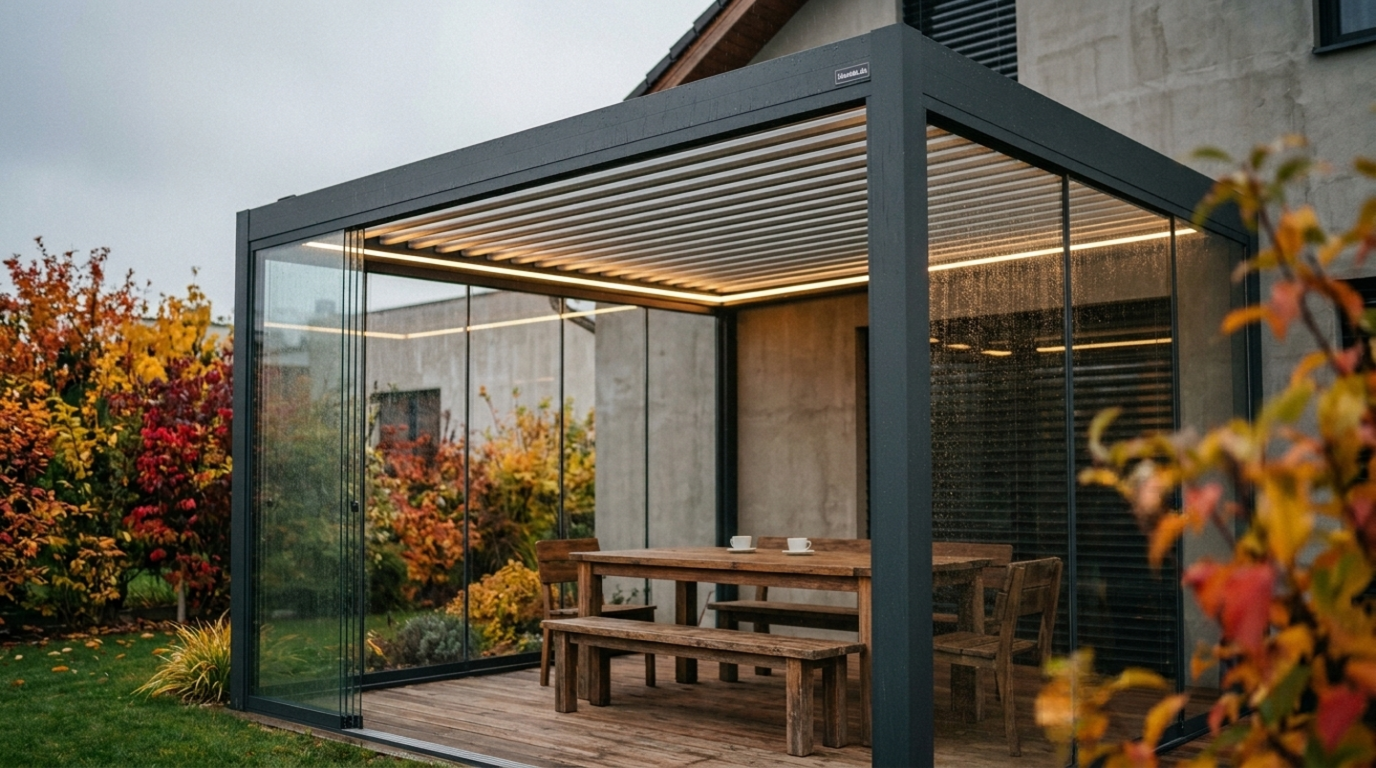
A bioclimatic pergola extends the season well beyond the traditional summer. From spring showers in April to autumn gatherings in October, the terrace remains functional and comfortable. While your neighbour's open terrace is unusable in May rain, under a bioclimatic pergola you can calmly enjoy a coffee and watch the raindrops bounce off the closed louvres.
For truly year-round comfort, it can be supplemented with side screen blinds or sliding glazing, which create an enclosed yet still airy space.
Temperature regulation and natural ventilation
Tilted louvres work like a chimney. Warm air rises and naturally escapes, cooling the space without air conditioning and without noise. This is the fundamental difference compared to a solid glass roof or polycarbonate, beneath which the typical greenhouse effect develops and summer stays become unbearable.
For environmentally conscious customers, this is a compelling argument: natural temperature regulation with zero electricity consumption.
Minimal maintenance and long service life
Aluminium as a material simply does not age. It does not corrode, crack, or rot, and UV radiation causes it no harm. No annual repainting, no impregnation, no winter protection needed. Occasional rinsing with water is all it takes to keep the structure looking brand new.
With proper installation, expect a service life of 15 to 25 years. Compared to fabric awnings or wooden structures, which require regular care and gradual replacement, an aluminium bioclimatic pergola is clearly the more advantageous choice.
Aesthetics and increased property value
The modern aluminium design complements virtually any architectural style — minimalist, industrial, or classic. You choose the colour from a full range of RAL shades or wood-effect finishes, so the pergola does not stand out but becomes a natural part of the home.
A well-designed pergola visually connects the house with the garden and genuinely increases the property's market value. It is not merely an aesthetic feature — it is an investment in the value of your property.
Types of bioclimatic pergolas: how to choose the right one?
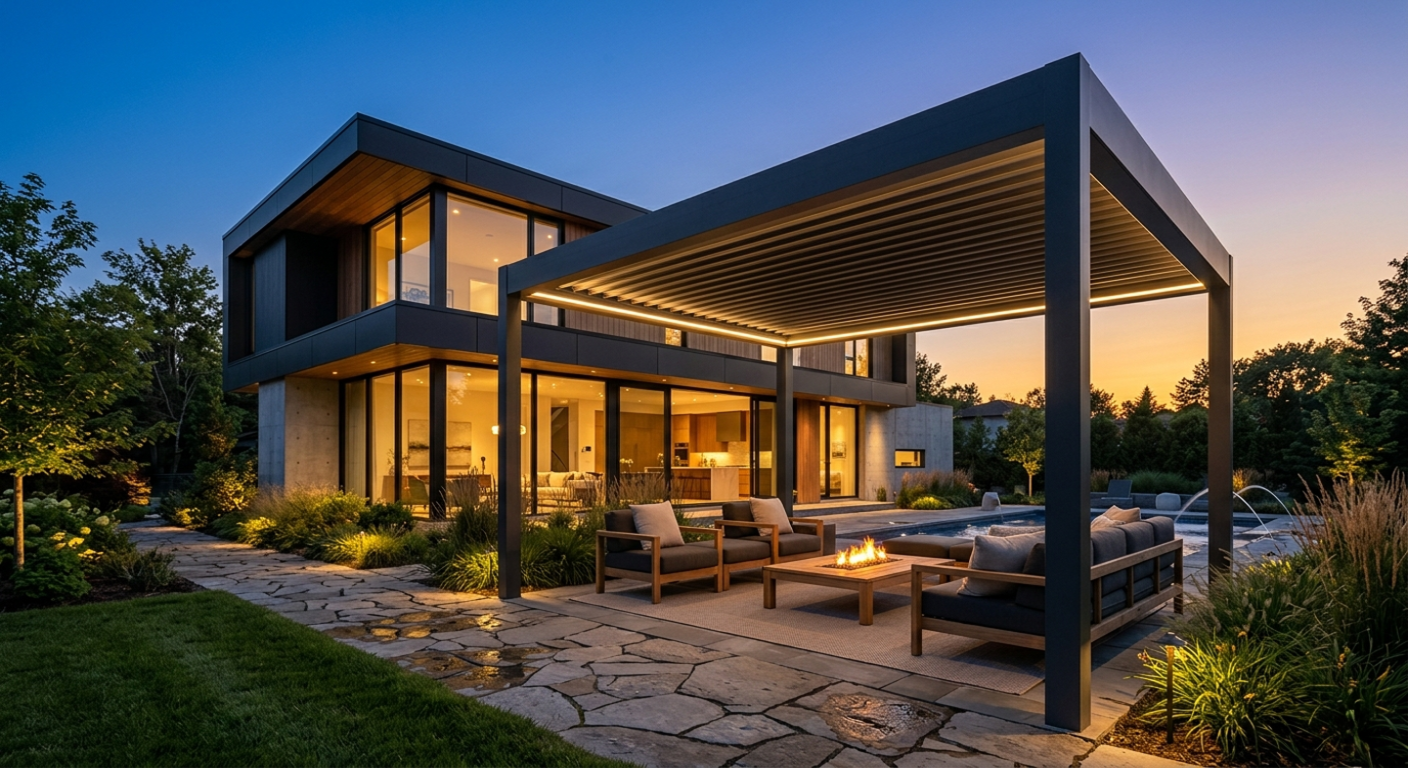
Freestanding (self-supporting) pergola
A freestanding pergola does not lean against the façade; you anchor it independently into the ground or floor. It is ideal for larger gardens, pool areas, or commercial spaces such as restaurants and hotels. You can freely choose the installation location regardless of where the building stands. Bear in mind that it requires a stable anchor and sufficient space.
Wall-mounted (attached) pergola
The most popular type for family homes and apartment terraces. One side attaches directly to the building façade, which means fewer posts, a cleaner appearance, and a smooth visual transition between interior and exterior. Direct access from the living room straight under the pergola becomes the most natural thing in the world.
Integrated pergola (without posts)
A premium option for discerning customers and contemporary buildings with an emphasis on minimalist design. The pergola is installed directly into a recess in the building or onto an existing structure. Water drainage is handled by a system of chain drains or concealed gutters. The result is clean, with no visible elements whatsoever.
Modular pergola
For large commercial areas, hotel and restaurant terraces. By combining multiple modules, virtually unlimited coverage can be achieved while maintaining a unified design.
Overview of bioclimatic pergola types
|
Pergola type |
Suitable for |
Installation |
Design |
Price |
|
Freestanding |
Garden, commercial |
Independent |
Flexible |
Medium to high |
|
Wall-mounted |
Home, terrace |
To façade |
Compact |
Medium |
|
Integrated |
Modern building |
Into recess |
Minimalist |
High |
|
Modular |
Hotel, restaurant |
Combined |
Uniform |
High |
What are bioclimatic pergolas made of?
Aluminium: the most popular and widespread material
Nearly 90% of bioclimatic pergolas on the market are aluminium, and for good reason. Aluminium is lightweight, corrosion-resistant, dimensionally stable, and can be powder-coated in any RAL shade. It withstands UV radiation, frost, and extreme temperatures without requiring any regular maintenance.
Steel load-bearing structure
Steel is used primarily in large commercial projects or where the customer already has an existing steel structure in place. Steel offers greater load-bearing capacity, but also greater weight. The louvres themselves are still made of aluminium in these cases; steel forms only the frame and uprights.
Combination of wood and aluminium
An aesthetically appealing and increasingly popular choice. A wooden load-bearing structure preserves the natural, warm character of the space, while aluminium louvres with a wood-effect finish bring modernity and functionality. Wood requires regular maintenance, but for customers who prefer a natural feel, this is a premium solution with an incomparable atmosphere.
Accessories and add-ons: a living room under the open sky
LED lighting integrated into the louvres
Imagine an evening atmosphere on the terrace without a single visible cable. Ambient LED lighting built directly into the pergola structure allows you to sit out well into the night and blends seamlessly with the overall design without any disruptive element. Choose between warm white for a cosy atmosphere or RGB for a more dynamic setting.
Side screen blinds and sliding glazing
Screen blinds protect the sides of the pergola from wind, insects, and sun. Sliding glazing goes even further, transforming the pergola into a fully enclosed winter garden that can be used even in cold weather.
Infrared heating
Infrared heating warms people and objects directly, not the surrounding air. It is therefore significantly more efficient than conventional heaters and allows comfortable outdoor seating even at temperatures near zero. For restaurants and hotels looking to extend the outdoor terrace season, it is an almost essential accessory.
Smart home integration and weather sensors
Premium bioclimatic pergolas connect to Apple HomeKit, Google Home, or Somfy TaHoma systems. Rain, wind, and sun sensors automatically adjust the louvre position without any input from the user. Should a storm break out, the louvres will close even while you are at work. When the sun comes out, the pergola opens and welcomes you home.
Bioclimatic pergola vs. other types of pergolas
Bioclimatic vs. fabric pergola
A fabric pergola offers a lower entry price and straightforward installation, but fabric is subject to wear and tear — it fades, tears, and cannot withstand tougher weather conditions. A bioclimatic pergola requires a higher initial investment, but repays it with a long service life, minimal maintenance, and year-round usability.
Bioclimatic vs. wooden pergola
A wooden pergola is aesthetically warm and natural, but requires annual treatment, may crack, absorb moisture, and eventually rot. An aluminium bioclimatic pergola simply has none of these concerns. There is also a compromise available: a wooden load-bearing structure with aluminium louvres, which combines the best of both worlds.
Bioclimatic vs. solid roof
A solid roof made of polycarbonate or glass provides maximum protection in all weather, but allows no ventilation control whatsoever. In summer, an unpleasant greenhouse effect develops beneath it. A bioclimatic pergola offers the ideal balance: full protection when you need it, and natural airflow when you want it.
Installation of a bioclimatic pergola
Substrate preparation and anchoring
The pergola must be anchored into a solid base — concrete or masonry. For wall-mounted pergolas, the load-bearing capacity of the façade must be verified in advance. Incorrect anchoring is the most common cause of instability in strong winds, which is why professional installation is not merely a recommendation, but a genuine necessity.
MontAlu has been active in the market since 1997 and has completed thousands of projects throughout Central Europe over that time. Expert installation is part of every order.
Electrical installation and motor connection
Motorised pergolas require an electricity supply. We recommend consulting an electrician before the structure itself is installed, so that the wiring can be concealed within the profiles and the result looks clean and professional. MontAlu coordinates the entire process, including the electrical installation.
Recommended dimensions and load capacity
A standard unit typically covers an area of up to 6 × 4 m, while modular combinations can achieve any larger dimensions required. The louvres are designed to handle loads typical for Central Europe — standardly around 90 kg/m², which corresponds to a heavy snow layer as well.
Price of a bioclimatic pergola
Factors influencing the price
The final price of a bioclimatic pergola depends on several variables:
-
Dimensions of the structure – a larger area means more material and more labour
-
Type of installation – freestanding requires more labour than wall-mounted
-
Surface finish – standard colours are less expensive than custom RAL shades
-
Accessories – motor, LED lighting, side blinds, and infrared heating all affect the final price
-
Installation complexity – accessibility of the site, terrain, required anchoring
Why it is worth investing in a quality pergola
Cheaper alternatives — tarps, awnings, and durable sun shades — need to be replaced or repaired every one to three years. A quality bioclimatic pergola with an aluminium structure functions for 15 to 25 years with no significant maintenance costs. When you compare this over ten years of use, an aluminium bioclimatic pergola works out not only cheaper, but more comfortable as well.
Moreover, it increases the resale value of the property and enables year-round use of the terrace, which has real financial value for every homeowner.
Frequently asked questions about bioclimatic pergolas
What is a bioclimatic pergola?
A bioclimatic pergola is an outdoor shelter with rotating aluminium louvres that allow you to regulate airflow, shading, and rain protection according to current conditions. Thanks to this flexibility, the terrace can be used year-round, not just in the summer months.
How do the rotating louvres work?
The louvres tilt by motor or manual crank within a range of 0° to 140°. They regulate the amount of incoming light, airflow, and protection from precipitation. Rainwater is channelled away through a concealed drainage system built directly into the support columns, so there is no dripping beneath the pergola.
Can a bioclimatic pergola withstand snow and wind?
Yes. The aluminium louvres are designed to handle loads typical for Central European climate conditions — standardly around 90 kg/m². Wind resistance depends on the anchoring and the specific model. In exceptional conditions, professional installation with anchoring in accordance with applicable standards is the key factor.
Is a building permit required for a bioclimatic pergola?
It depends on the dimensions and the specific location. In most cases, for standard dimensions intended for a family home, a building permit is not required, but we recommend verifying the situation with the local building authority. The MontAlu team will be happy to advise you on this administrative matter.
How long does the installation of a bioclimatic pergola take?
Standard installation of a typical pergola takes one to two working days. Larger projects with accessories such as LED lighting, side blinds, or infrared heating may take two to three days. The exact timeframe depends on the availability of the installation team and the readiness of the substrate.
Can I connect a bioclimatic pergola to my smart home?
Yes. Premium models support integration with Somfy TaHoma, KNX, Apple HomeKit, or Google Home systems. Rain and wind sensors automate control without any user intervention, which is particularly practical when you are away from home.
Frequently Asked Questions
What is a bioclimatic pergola and how does it work?
The principle behind a bioclimatic pergola is simple yet ingenious. The roof is neither solid nor fabric, but made up of a system of rotating aluminium louvres that respond to your needs or directly to the weather. This very flexibility is what makes a bioclimatic pergola more than just a shelter. It is an intelligent exterior element that combines architecture, comfort, and technology in one.
Why choose a bioclimatic pergola? The main advantages Year-round use of the terrace
A bioclimatic pergola extends the season well beyond the traditional summer. From spring showers in April to autumn gatherings in October, the terrace remains functional and comfortable. While your neighbour's open terrace is unusable in May rain, under a bioclimatic pergola you can calmly enjoy a coffee and watch the raindrops bounce off the closed louvres.
Types of bioclimatic pergolas: how to choose the right one? Freestanding (self-supporting) pergola
A freestanding pergola does not lean against the façade; you anchor it independently into the ground or floor. It is ideal for larger gardens, pool areas, or commercial spaces such as restaurants and hotels. You can freely choose the installation location regardless of where the building stands. Bear in mind that it requires a stable anchor and sufficient space.


