
Why does a conservatory overheat in summer
The answer is physics. The greenhouse effect isn't just a term from climatology it's exactly what happens in your conservatory on every sunny day. Sunlight passes through the glass or polycarbonate roof and walls into the interior. There it converts into heat. That heat, however, can't easily escape back out the glazed structure traps it like a snare.
The larger the glazed area, the more intense the effect. Modern aluminium conservatories usually have large glass areas, which is both their greatest strength and their biggest thermal risk during the summer months. A south-facing roof can capture, in July, a heat output comparable to several electric heaters running at once.
The temperature in a conservatory without any protective measures can easily exceed 45–50 °C on a sunny day in July values at which staying inside isn't pleasant even briefly. Understanding this mechanism is the first step toward the right solution.
The most common mistakes in conservatory design
Overheating rarely happens by accident. It usually has clear causes rooted already in the conservatory design phase. Here are the most common ones:
Orientation without accounting for summer. A conservatory facing south or southwest receives the most welcome solar warmth in winter, but in summer that same sun causes overheating. A proper design accounts for this in advance and includes protective measures.
No shading included in the project. Shading is far too often addressed only after construction is finished, once the problem is obvious. Yet it's far more effective and cheaper to build it in from the start. Mistakes in conservatory construction often come down to exactly this: thermal comfort in summer gets forgotten.
Choosing the wrong glass. Standard clear glass lets through almost all solar radiation. Without a solar-control layer or special coating, heat builds up unchecked.
Insufficient or missing ventilation. An enclosed space with no air circulation overheats extremely quickly. If the structure doesn't include roof windows or side ventilation elements, the air simply has nowhere to go.
Materials with high thermal mass. Dark floors, masonry walls, or massive interior elements absorb heat during the day and release it at night which extends thermal discomfort into the evening hours.
Glass and structure determine the temperature
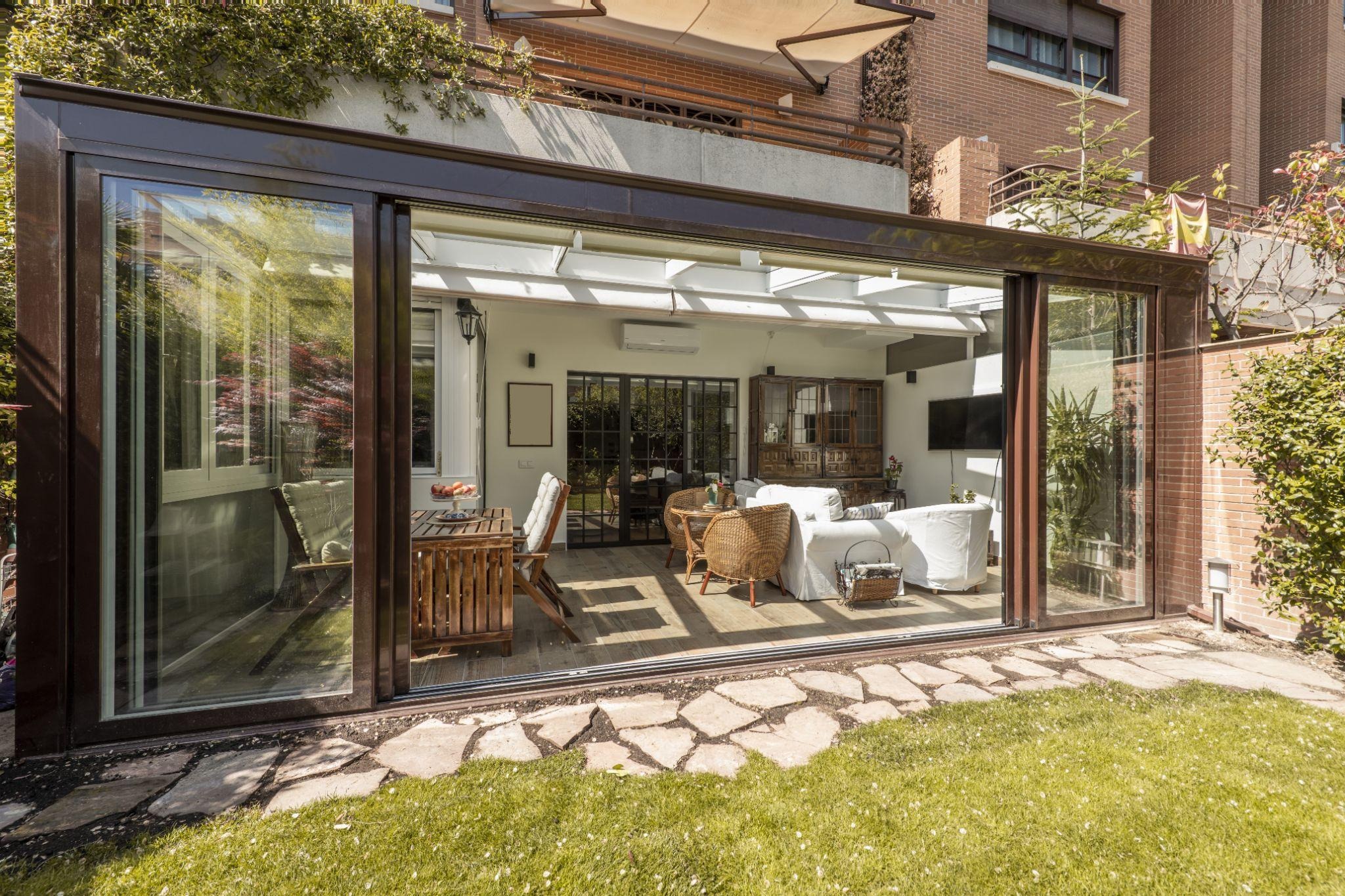
Choosing the glass is perhaps the most important decision for a conservatory in terms of thermal comfort. Insulating glass (double or triple glazing) reduces heat losses in winter, but insulation alone isn't enough to protect against summer overheating. Specialized coatings are needed for that.
Solar-control glass contains a special coating (most often metal-oxide based) that selectively reflects part of the solar radiation before it even enters the interior. Quality solar-control glass lets through plenty of natural light while reducing heat gain by 30–60%. That's the difference between a pleasant environment and an unbearable one.
For roof surfaces, it's ideal to use glass with a low solar factor (known as the g-value). The lower the value, the less heat the glass lets through. The roof receives sunlight at a perpendicular angle that is, at maximum intensity which makes it the most critical part of the whole structure.
An aluminium conservatory has one key advantage over timber structures: aluminium is a thermally undemanding material that doesn't overheat or store heat the way dark wooden profiles do. Modern aluminium profiles are also fitted with thermal breaks so-called thermo-bridges that prevent heat transfer through the structure. The result is a more stable indoor temperature throughout the year.
External shading as the most effective solution
If you're looking for the single most effective measure against overheating, it's external shading. The principle is simple: you stop the sunlight before it ever reaches the glass. Outdoor solutions are therefore many times more effective than indoor blinds or curtains.
Outdoor roller shutters are a classic, proven solution. They provide complete shading, good thermal insulation, and sound insulation as well. They can be operated manually or motorized, and on a conservatory they can be integrated directly into the aluminium frame. Another advantage is protection against wind and rain.
Screen blinds (awnings made from a special screen-printed fabric) are a modern alternative that preserves the view outside while significantly reducing heat gain typically by 60-85%, depending on fabric density. Terrace shading solutions from MontAlu also include screen technology suited specifically for glazed structures.
An awning for a conservatory is a solution suited especially for side walls, or where you want a combination of shading and rain protection. Cassette awning or electric awning also works well aesthetically it doesn't protrude from the structure and is completely hidden when retracted.
Quick comparison:
|
Shading type |
Effectiveness |
View preserved |
Suitable for |
|
Outdoor roller shutters |
★★★★★ |
No |
Roof + walls |
|
Screen blinds |
★★★★☆ |
Yes |
Walls, roofs |
|
Awnings |
★★★★☆ |
Partially |
Side walls, terraces |
|
Indoor blinds |
★★☆☆☆ |
Yes |
As a supplement |
Ventilation and air circulation
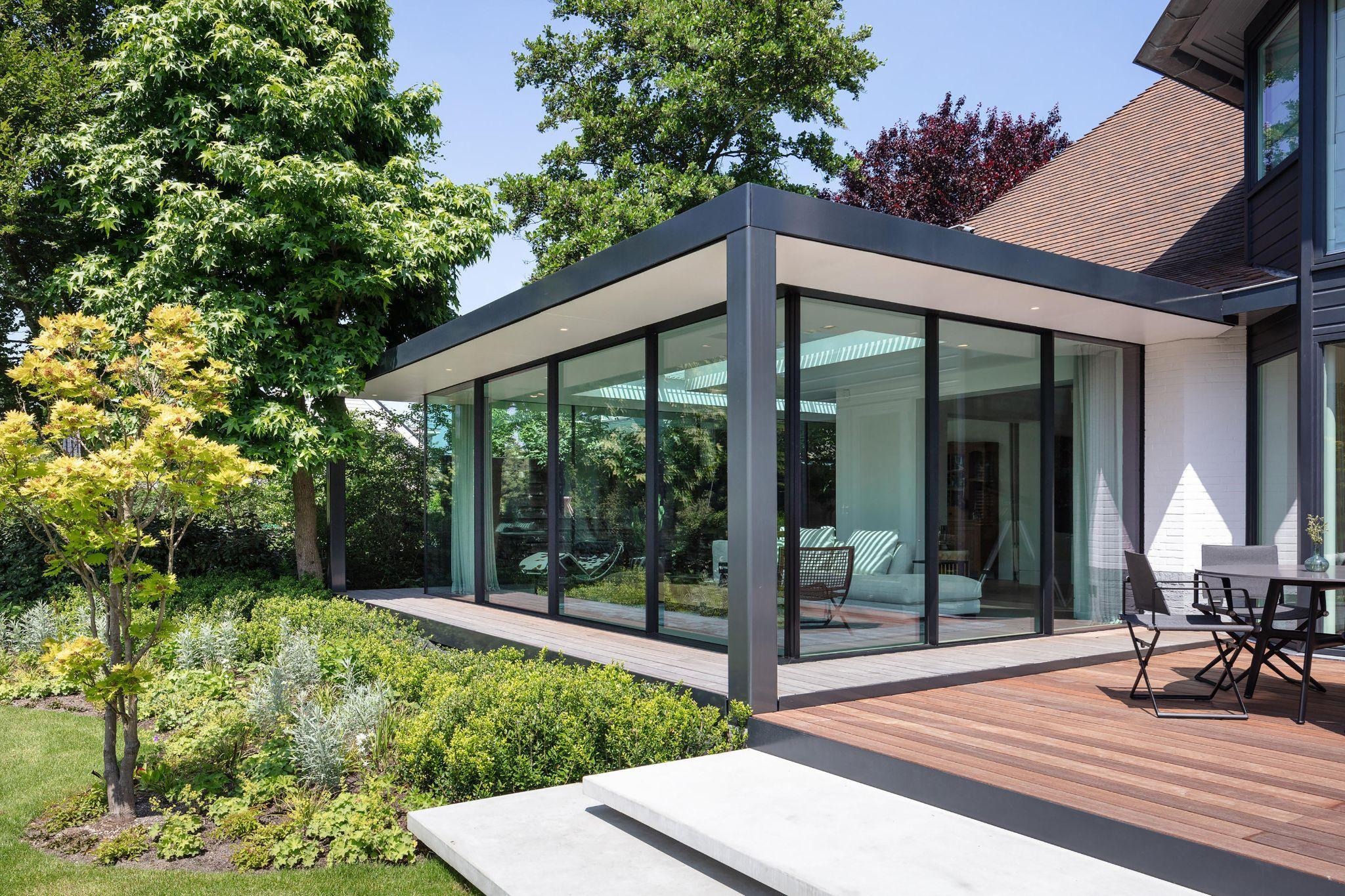
Even the best shading isn't enough if the air inside stagnates. Ventilating a conservatory is the second key pillar of thermal comfort. Properly designed circulation can lower the felt temperature by several degrees without any technology at all, using nothing but the laws of physics.
Natural air circulation works on the principle of the stack effect: warm air rises and needs somewhere to escape. That's why roof windows are almost a necessity in a conservatory. If you open the roof windows together with side windows lower down, a flow of fresh air forms that effectively cools the interior.
For maximum effect, the rule is: the opening for warm air to escape (at the top) should be at least as large as the opening for fresh air intake (at the bottom). In practice, that means a roof window with automatic opening, ideally linked to a temperature sensor that opens it automatically once a set value is reached.
Another option is ventilation grilles at the bottom of the structure, or a hidden ventilation system built into the aluminium profiles. For custom-made conservatories from MontAlu, these elements can be incorporated directly into the project the result is elegant and functional at the same time.
Smart technology for temperature control
Smart shading takes protection against overheating to a whole new level. Automated systems react to current conditions in real time, so you don't have to check the weather forecast every day and manually adjust the shutters.
Temperature and sun sensors (solar sensors) measure the intensity of sunlight and automatically activate shading the moment it's needed. When a cloud covers the sun, the shutters retract again, giving you maximum light comfort with minimal heat load.
Automatic control can also combine shading and ventilation: as the temperature rises, a roof window opens and an external shutter activates at the same time. This kind of synergy can keep the temperature pleasant even on the hottest summer days.
Integration into a smart home (smart home systems such as KNX, Loxone, or simple WiFi solutions) allows control from your phone, scheduling, and combination with other systems in the home air conditioning, lighting, or security.
Investing in smart shading pays off significantly with larger glazed areas, where manual control isn't just inconvenient it's also less effective, since a person simply can't react as fast as a sensor.
Vegetation and interior solutions for cooling
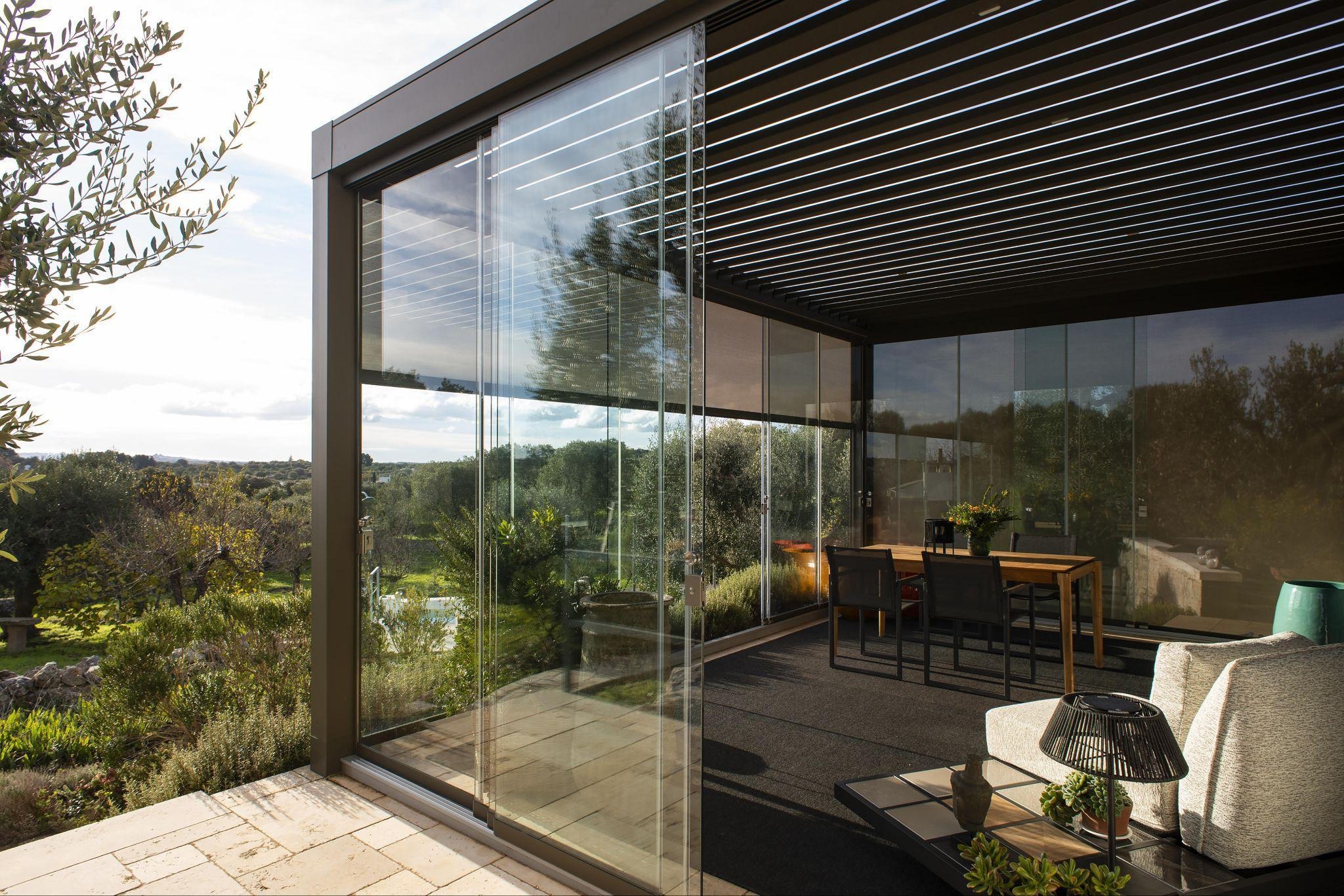
Plants in a conservatory aren't just decoration — they're a functional element of microclimate regulation. The process of transpiration (water evaporating through the leaves) cools the surrounding air. Larger plants with extensive foliage such as ficus, banana plants, or climbing plants can lower the felt temperature around them by 2-4 °C.
A green wall is a more intense version of the same principle. A vertical garden of dense plants creates not only a visually striking interior but also natural air conditioning. It also improves air quality and reduces noise levels.
The interior microclimate can also be influenced by material choice: light-colored surfaces reflect heat, while natural materials with low thermal capacity heat up more slowly. Ceramic tiles or natural stone do store heat, but they release it at night which can be an advantage in certain climate conditions.
Interior shading (blinds, shutters on the inner side of the glass) is less effective than external solutions, but it can serve as a supplement for example to regulate light and privacy during the day.
How to combine solutions for maximum effect
You won't get the best results from a single measure, but from a combination of shading and ventilation together with the right choice of materials. Here's a recommended combination for real comfort during the summer months:
The basis - the right glass: Solar-control insulating glass with a low solar factor (g ≤ 0.35) on the roof. This is a fundamental measure that's best addressed during construction.
The first line of defense - external shading: Outdoor roller shutters or screen blinds on the roof and south-facing surfaces. They activate automatically in intense sunshine. Conservatory shading should be part of every project.
The second line - ventilation: Roof windows with automatic opening and side ventilation elements. They ensure warm air is expelled and fresh air is brought in.
A supplement - vegetation and interior elements: Larger plants, light-colored surfaces, and possibly interior shading for light control.
Optimization - smart control: Sensors and automation that coordinate shading and ventilation without requiring your daily attention.
With this kind of combination, effective cooling of a conservatory is achievable without air conditioning, or with minimal reliance on it which significantly saves on operating costs.
How much does cooling a conservatory cost
The investment depends on the size of the conservatory, the chosen solution, and whether it's addressed during construction or added later. Approximate prices:
Solar-control glass (during construction): The surcharge over standard insulating glass ranges from 15 to 40% of the glazing cost. For a 20 m² conservatory, that can be €500 to €1,500. It's the cheapest form of prevention if addressed in advance.
External roller shutters or screens: For a typical conservatory, expect an investment in the range of €1,500-5,000, depending on the dimensions and the system chosen. Motorized solutions are more expensive, but more convenient and more advantageous in the long run.
Awnings: Cassette awning or electric awning for side shading from €800 to €2,500 depending on the dimensions.
Smart system (sensors + automation): Basic shading automation including sensors from €400 to €1,200. Comprehensive smart home solutions are more expensive but bring a level of comfort you'll appreciate every day.
Roof windows with motorized opening: From €300 per piece, including installation.
Important: The cost of conservatory shading addressed during construction is always lower than adding it afterward. If you're planning a custom-made conservatory, include shading in the project from the start you'll save time, money, and complications.
Conclusion
Overheating in a conservatory in summer isn't fate it's a problem with a solution. The key, however, isn't a single miracle element, but a systemic solution: the right glass, external shading, functional ventilation, and if you want maximum comfort smart automation. Each of these elements contributes to the result, but you'll get the best effect by combining them.
A conservatory that works year-round pleasant in January and in July isn't a dream. It's a matter of the right design and well-chosen technology. And that's exactly what we work on with every project.
Design a conservatory that works year-round – without overheating and without compromise. Contact us or simply calculate the price in the configurator a custom quote within 24 hours.
Frequently asked questions (FAQ)
Can a conservatory be cooled completely without air conditioning?
Yes. With the right combination of external shading (roller shutters or screens), functional ventilation (roof windows, side elements), and suitable glass, you can maintain a pleasant temperature even on the hottest summer days. Air conditioning can serve as a supplement during extreme heat, not as the main solution. The key is a systemic approach — not a single isolated measure.
Which shading is most effective?
Outdoor screens and roller shutters are clearly the most effective, since they stop solar radiation before it ever touches the glass. Indoor blinds are less effective — the heat reaches the glass and is partly transferred to the interior before an indoor blind can catch it. For roof surfaces, special wind-resistant roof shutters are the most suitable.
Is smart shading worth it?
Yes, especially for larger glazed areas. Smart shading with automatic control and sensors reacts faster than a person, works even while you're away, and saves energy in the long run. Compared with air-conditioning costs, the payback period is typically 3–5 years. For luxury conservatories or larger custom-made conservatories, smart shading is practically standard.
Frequently Asked Questions
Frequently asked questions (FAQ) Can a conservatory be cooled completely without air conditioning?
Yes. With the right combination of external shading (roller shutters or screens), functional ventilation (roof windows, side elements), and suitable glass, you can maintain a pleasant temperature even on the hottest summer days. Air conditioning can serve as a supplement during extreme heat, not as the main solution. The key is a systemic approach — not a single isolated measure.
Which shading is most effective?
Outdoor screens and roller shutters are clearly the most effective, since they stop solar radiation before it ever touches the glass. Indoor blinds are less effective — the heat reaches the glass and is partly transferred to the interior before an indoor blind can catch it. For roof surfaces, special wind-resistant roof shutters are the most suitable.
Is smart shading worth it?
Yes, especially for larger glazed areas. Smart shading with automatic control and sensors reacts faster than a person, works even while you're away, and saves energy in the long run. Compared with air-conditioning costs, the payback period is typically 3–5 years. For luxury conservatories or larger custom-made conservatories, smart shading is practically standard.


